Introduction
Movement frequently takes a backseat in today’s fast-paced, largely seated world. We often don’t realize how much sitting affects our bodies and minds, whether it’s at work, on the couch, or during commutes. The truth is that you can feel better by simply moving more; you don’t need a gym membership or an ideal routine.
Every bit of movement matters, whether it’s dancing in your room, taking the stairs, stretching in between tasks, or going for a morning walk. Maintaining an active lifestyle improves your mood, energy levels, focus, and long-term health.
Every little bit counts, whether it’s a few stretches between tasks, taking the stairs instead of the elevator, or adding a short walk in your morning routine. Regular movement supports your cardiovascular system, strengthens muscles, improves flexibility, and enhances mood. By committing to an active lifestyle, you can boost energy levels, sharpen focus, reduce stress, and improve your long-term health. Movement doesn’t have to be complicated or time-consuming; even small bursts of activity can create significant benefits when performed consistently.
Jumping Jacks
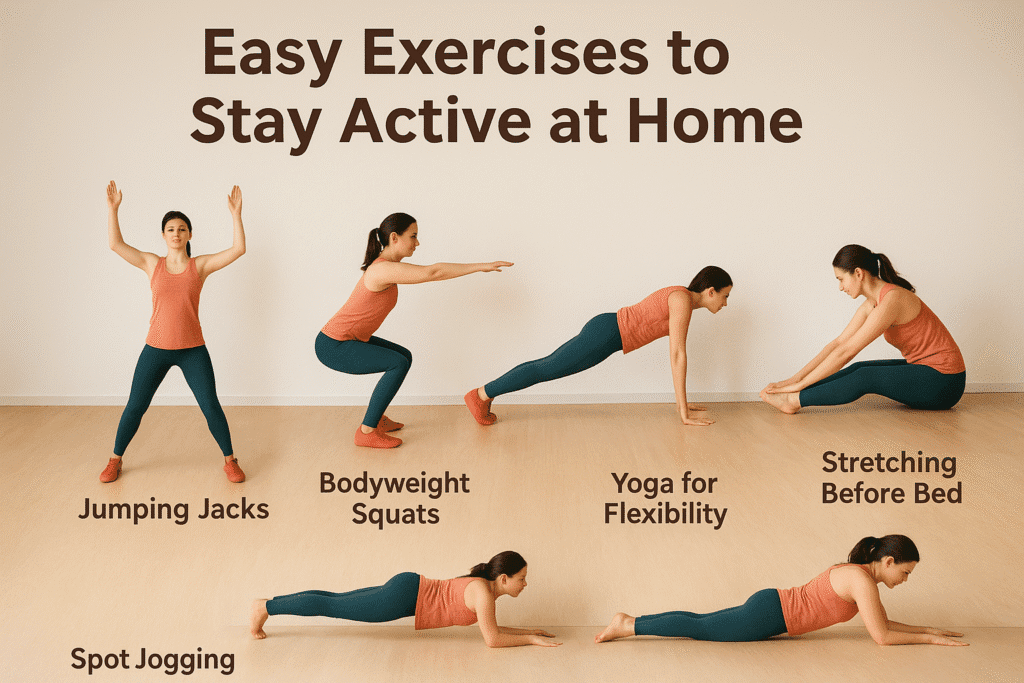
Despite their simple appearance, jumping jacks are an effective full-body workout that you can perform anywhere, at any time. Jumping jacks for just 30 seconds raises your heart rate, burns calories, and works your arms, legs, and core without the need for any special equipment. By increasing blood flow and releasing feel-good endorphins, they also aid in enhancing mood, circulation, and coordination. Jumping jacks are an easy way to increase movement and feel more alive, whether you do them as part of a home workout, as part of your warm-up, or as a midday energy boost.
The rhythmic motion and cardiovascular benefits stimulate the release of endorphins, the body’s natural “feel-good” chemicals, which help improve mood and reduce stress. Jumping jacks are versatile—they can be used as a warm-up before other exercises, a quick energy booster during a midday slump, or part of a full home workout routine.
Because they require no equipment and very little space, jumping jacks are an ideal option for anyone looking to move more, regardless of fitness level. Even a few minutes of jumping jacks each day can elevate heart health, increase energy, and strengthen muscles over time.
Bodyweight Squats
One of the easiest yet most efficient exercises for developing lower body strength without the use of any equipment is the bodyweight squat. They work your calves, thighs, glutes, and core, which enhances posture, mobility, and balance. When performed correctly, they also promote joint health and burn calories. Squats are easy to incorporate into your day, whether you perform 10 or 50. You can do them as part of a quick routine at home, during breaks, or after waking up. No gym? No issue. The gym is your body.
Squats are extremely adaptable: you can do 10 for a quick warm-up, or 50 as part of a longer routine. They can be incorporated throughout the day, whether during breaks, before bed, or as part of a morning ritual. Even without access to a gym, your own body is sufficient to create resistance, build strength, and improve overall mobility. Regular squatting strengthens the lower body, enhances daily functional movement, and can even make climbing stairs or lifting objects easier and safer.
Push-ups (Wall or Floor)
A traditional bodyweight exercise that works your arms, shoulders, core, and chest, push-ups require no special equipment. Start with wall push-ups, which are less taxing on the joints but still effective, if floor push-ups seem too difficult. You can advance to full floor or incline push-ups as your strength increases. Your entire system will be energized, your posture will improve, and your upper body power will increase with even a few repetitions per day. Push-ups are easy, adaptable, and effective; they meet you where you are.
Push-ups also improve posture by strengthening muscles that support the spine, enhance balance, and promote overall stability. Doing even a few push-ups daily can energize the body, improve upper body strength, and build confidence in one’s physical abilities. They require no equipment, are highly adaptable, and can easily be integrated into a morning routine, a work break, or an evening workout.
Over time, consistent push-up practice can lead to improved muscle tone, endurance, and functional strength for everyday tasks.
Spot Jogging
No room? No issue. Jogging in place, or spot jogging, is a simple and efficient method to increase energy, burn calories, and get your heart rate up without having to leave your room. It is an excellent option for warm-ups or brief indoor workouts because it enhances cardiovascular health, leg strength, and endurance. There’s no need for a treadmill or running track—just a few minutes of spot jogging can wake up your body, clear your head, and get rid of sluggishness!
Like traditional jogging, spot jogging stimulates circulation, enhances metabolism, and releases endorphins, which boost mood and mental clarity. No treadmill or running track is necessary—just a small open space and a few minutes. Even short bursts of spot jogging can break up long periods of sitting, reduce stiffness, and increase overall daily movement. With consistent practice, this simple exercise can contribute to stronger legs, improved heart health, and greater stamina for daily activities.
Planks
An isometric core strength exercise that involves holding a position akin to a push-up for a prolonged amount of time is the plank. It entails keeping your head and heels in a straight line, using your core muscles, and holding the pose without allowing your hips to rise or fall.
The advantages of planks
Core Strength: Your abs, back, and obliques are among the core muscles that planks are great for building.
Better Posture: A robust core can lower the risk of back pain by enhancing stability and posture.
Enhanced Stability: During a variety of physical activities, planks help your body stay stable.
Decreased Back Pain: Lower back pain is less likely to occur when the spine is supported by a strong core.
A strong core supports better posture, reduces the risk of lower back pain, enhances stability, and improves performance in other exercises. Planks also train endurance and coordination, providing benefits that extend beyond the exercise itself. Even holding a plank for 20–60 seconds each day can result in noticeable improvements in posture, balance, and core strength.
Variations, such as side planks or forearm planks, allow you to target different muscle groups and progressively challenge your strength. Consistently including planks in your routine builds a resilient core, which is essential for both athletic performance and everyday functional movement.
Yoga for Flexibility
Practicing yoga can help you become more flexible. In order to increase range of motion and decrease stiffness, some yoga poses, such as those found in Hatha or Yin yoga, are specifically made to stretch muscles and connective tissues. Regular yoga practice can result in observable gains in general mobility and flexibility.
Flexibility-enhancing yoga poses:
Cat-Cow: This pose increases flexibility and gently warms the spine.
Downward-Facing Dog: This pose increases flexibility in the upper body and back of the legs by stretching the hamstrings, calves, and spine.
Low Lunge: This pose increases flexibility in the front of the hips and thighs by working the quadriceps and hip flexors.
Cobra Pose: This pose improves flexibility in the front of the body by stretching the chest and abdomen.
Certain yoga poses are especially beneficial for flexibility: the Cat-Cow pose warms and mobilizes the spine, Downward-Facing Dog stretches the hamstrings, calves, and back, Low Lunge targets the hip flexors and quadriceps, and Cobra Pose opens the chest and stretches the abdomen
Beyond physical flexibility, yoga promotes mindfulness, body awareness, and stress reduction. Even short daily sessions can make muscles feel longer, reduce stiffness, and improve overall functional movement, allowing you to move more freely and comfortably in daily life.
Stretching Before Bed
Your sleep can be greatly improved by doing a few easy stretches before bed. By stretching, you can ease your body into rest mode, slow down your breathing, and release tension from tense muscles. After a long day, simple exercises like leg stretches, child’s pose, and neck rolls can help relax the nervous system and lessen stiffness. It’s a calm method of telling your body that it’s time to unwind. Stretching for just five to ten minutes can result in deeper, more restful sleep and a softer morning.
Spending just five to ten minutes stretching at night can lead to deeper, more restorative sleep and a refreshed morning. Regular bedtime stretching can also reduce the risk of waking up with soreness, improve circulation, and enhance overall body awareness. Incorporating this habit into your nightly routine is an easy yet powerful way to support recovery, relaxation, and general wellness.
Explore this related topic here
Daily Routine for Full Body Wellness
Heart Health: 6 Best Morning Habits to Start Your Day Right
Conclusion: Home is Your Gym
To stay active, all you need is your body and a little willpower; you don’t need expensive equipment, a membership card, or an ideal routine. Simple exercises performed at home, such as yoga, spot jogging, jumping jacks, and planks, can significantly improve your strength, energy, and mood.
Your home can be the starting point for your health, not just a place to sleep. All you need is a few minutes each day, a little consistency, and the will to take care of yourself. Increase your physical activity, improve your health, and make your house the starting point for your fitness journey.For detailed instructions on easy exercises to stay active at home, refer to this Harvard Health guide.
Your home can serve as a hub for physical activity, rather than just a place to rest. Even a few minutes of consistent effort each day will add up over time, helping you maintain mobility, flexibility, and energy. By integrating movement into daily life, you reduce the negative effects of prolonged sitting, enhance mood and mental clarity, and strengthen the body from head to toe.
Start small, stay consistent, and embrace your home as a fitness space. The journey toward better health is accessible, simple, and effective—right at your fingertips. For additional guidance on practical exercises and routines that can be done at home, resources like the Harvard Health guide provide detailed instructions to help you maximize the benefits of daily movement.